Original link of this post on linkedin : click here
New technologies for an energetic transition
Average temperature is undeniably rising on our beloved planet. The recent example of the Svalbard Global Seed Vault, a bunker located in the Norwegian archipelago beyond the Arctic Circle, strikingly illustrates the threat of this climate change. There are stored the most valuable crop seeds of humanity, in a supposed-to-be-indestructible building buried inside the mountains. However, the world’s largest collection of crop diversity is today threatened by floods that occur because of ice melting. Integrating renewable energies, such as wind, tide, hydraulic, geothermic and solar energies, into our energetic program is therefore a necessity to limit greenhouse gas emissions. Although some countries like Germany, the Netherlands or Iceland have made clear progresses in the exploitation of some of these renewable energies, these latter ones are today considered as complementary to our oil-based energy production rather than potential major sources of energy. Setting up new technologies in order to produce further renewable energy is consequently a key objective. Among the ingenious technologies that are today emerging and promising, some take benefit from photosynthetic organisms. These technologies are called biophotovoltaics and plant microbial fuel cells and rely respectively on microalgae/cyanobacteria and vascular plants.
Creating a plant battery
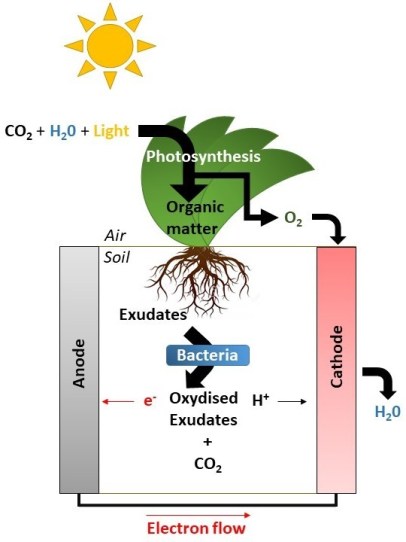
Plants capture sunbeam energy and consume atmospheric CO2 to produce organic matter (that we eat) and O2 (that we breath). At the root-level, some of the organic matter is released and then oxidized by soil bacteria, resulting into the release of electrons. In a nutshell, photosynthesis converts solar energy into chemical energy, which is converted into electrical energy by oxidation. Interestingly, photosynthesis and oxidation are coupled in the same compartment in unicellular cells like microalgae or cyanobacteria. The concept of biophotovoltaics and plant microbial fuel cells consists in associating electrodes to create an electric flow with the free electrons that result from the oxidation of organic compounds. As a matter of fact, this principle is a variation of the well-known Daniel Cell. Outstanding enough, while photosynthesis itself only takes place by day when the sun is shining, the oxidation of organic matter takes place by day just as well as by night, allowing a continuous flow of electrons. Although this appears very promising, the electrical current obtained is weak, constituting today a major limitation for this technology.
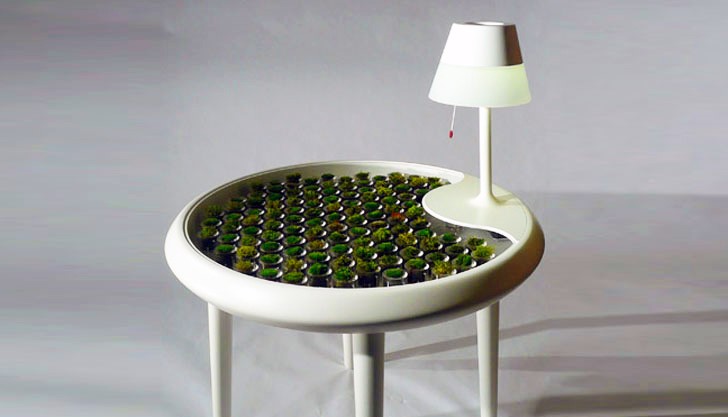
Optimizing biophotovoltaics and plant microbial fuel cells to make efficient electrical supply is the challenge tackled by two European start-ups, Bioo (based in Barcelona, Spain) and Plant-e (based in Wageningen, the Netherlands); as well as research laboratories such as the Department of Biochemistry and the Plant Metabolism group, both located at University of Cambridge, UK. As the electric current that can be obtained is still limited, these technologies are mainly applied on prototypes (P2P solar hub, the Moss FM) or on few small items such as a LED powered by ornamental plants from Plant-e, or a wifi transmitter plant from Bioo. Bioo is also currently developing a phone charger plant and a grass panel providing electrical energy. I myself built my own prototype for fun. Scientific studies could assess whether some plant species are more prone to release organic matters into the ground. Discovering (or engineering) bacteria with particular increased organic matter break down activity would also be a track of investigation to improve the electricity production.
Towards all green cities?
At the era of massive urbanization, we are more and more surrounded by asphalt, and crave to reconnect with nature. Biophotovoltaics and plant microbial fuel cells open up endless applications and perspectives. It is now possible to imagine a world where plants are no longer used for decoration, but also to provide electricity. Waiting for the optimization of these technologies, it might not be a dream anymore to think of self-sufficient housings that produce electricity thanks to their garden, or street lamps working thanks to trees bordering the roads. Cyanobacteria and algae bioreactors might also be used on building facades to simultaneously produce electricity and bio-fuels. By developing these technologies, we could reinforce the symbiotic relationship we have with plants, and it would be an important step towards solving our energetic transition.


 Valentin Hammoudi