The definition of “self”and “non-self” differs depending on whether you tackle it from a biological or from a philosophical point of view. Biologically speaking, self is defined as your cells, and everything else is non-self. Philosophically speaking, self is what makes you an entity, in its entirety. With scientific progress over the last decades, we understand more and more that the biological definition of self might not be in line with reality. As a human being, you might not be as much you as you think.
Your body contains foreign cells
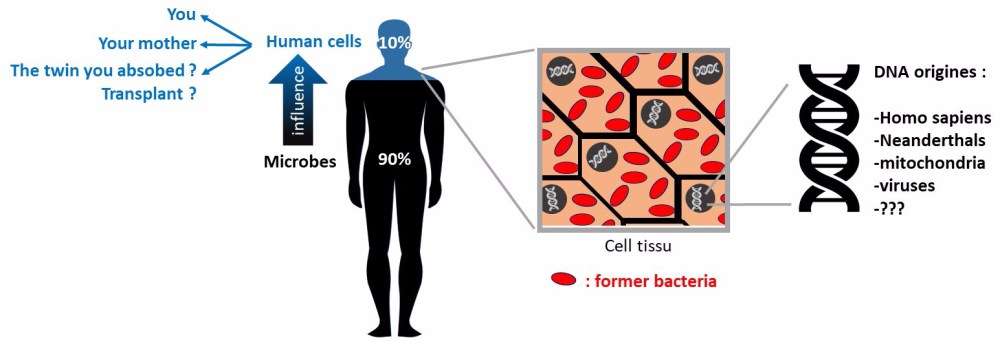
First of all, your body is not exclusively composed of cells from “you”. During fetal development, you inherit cells from your mother that can be found in various parts of your body, including your liver, lungs, heart, brain, kidneys, and even your reproductive organs. These maternal cells are able to continue to grow and reproduce inside your body, sometimes for your entire life. In the opposite scenario, some of your own fetal cells can also migrate to your mother’s body and remain there for years after birth.
In extremely rare cases, two fertilized eggs can fuse together during early development, resulting in an embryo that has genetically distinct cells from two siblings. This phenomenon is known as chimerism and can lead to some fascinating genetic makeup (if you want to know more about the mind-boggling story of a woman who was not genetically the mother of her children, have fun here). Of course, the more common scenario of receiving a transplant or blood transfusion can also introduce foreign cells into your body. It’s incredible to think about the various sources of cells that make up our bodies, blurring the lines of what it truly means to be “ourselves.”
Your DNA is a Melting pot
So your body may not only be composed of your cells, but at least, they are still human cells. But what makes you belong to Homo sapiens species? Your genes? Sorry to disappoint you again, but it’s a little more complicated than that. Our species, Homo sapiens, is the last surviving species of the human kind. A few hundred thousand years ago, other human species coexisted with Homo sapiens, such as Neanderthals or Denisovans. Their geographical distribution differed, but there were potential encounters. Likewise today, you would say that felines coexist: leopards, tigers or cougars do not live on the same territories, but it is not totally impossible that some of them bump into each other. Deep analysis of our DNA showed a few years ago that a small part of our DNA comes from Neanderthals. The DNA percentage actually varies depending on the geographical origin of your ancestors, but it is around 4%. This ground breaking discovery suggests that sexual intercourse (resulting in progenies) happened between Homo sapiens and Neanderthals : this is called an hybridation event. When hybridation occurs between two species, useless genes are generally eliminated by genetic drift, over generations. Though, we have kept some genes for hundreds of thousand years in our genome, meaning that there must be benefits coming from these genes. In fact, the genes that we inherited from Neanderthals are still active, and some of them are involved in insulating skin or immunity towards some specific pathogens. Actually, the analysis of our DNA suggests that several hybridation events took place along the history of humans, for instance between Homo sapiens and Denisovan in Eastern Asia.
So, you may be wondering if all the DNA in your body is actually from living organisms. However, it turns out that even that is not entirely true. While it’s true that your DNA comes primarily from living organisms, there are some exceptions. Your cells contain mitochondria, which are little compartments that act as power plants. These mitochondria were once free-living bacteria that were engulfed by another cell and developed a symbiotic relationship. The bacteria eventually evolved to focus solely on energy production and exported most of their genes into the host cell’s DNA. This process marked the beginning of complex life and gave rise to plants, animals, and fungi.
But it doesn’t stop there. Your DNA is not only composed of genes, but also non-coding sequences called “junk DNA”. While the role of some of this non-coding DNA is still being uncovered, around 10% of your total DNA is made up of remnants of former viral DNA. This means that a portion of your DNA actually comes from non-living things, as viruses are not classified as living organisms. It’s possible that there are even more sources of DNA in your body that we have yet to discover.
You are more microbes than human
In the end, perhaps “human cell” implies the notion of “DNA melting pot”. Then, you can see your body as a pure human entity . One last time: not even close! Microbes (bacteria and fungi) are omnipresent on your skin, in your genitals, in your mouth, in your guts, below your nails and on your eyes. Do not panic though, most microbes are either neutral or beneficial. Indeed, you and many microbes have developed a symbiotic relationship: it’s a win-win situation where partners trade valuable goods with each other. For instance, in your guts live bacteria that digest food you cannot process yourself, bacteria that synthesize vitamins for you, bacteria that degrade toxins and bacteria that prime your immune system. In fact, pathogenic microbes are rather the exception than the rule. And if they managed to break through, beneficial microbes compete with them, restricting their potential success to cause harm. But the influence of symbiotic bacteria on you may go beyond what you think. Unbalanced gut flora may be involved in obesity or depression. Even crazier, a hypothesis was raised a few years ago proposing that bacteria may influence your behaviors towards food by secreting precursors of serotonin and dopamine, two hormones respectively involved in pleasure and rewarding process. Know that guts are so rich in nervous cells and that they are widely connected to the brain, there is no doubt that microbes in your gut influence your life more than you believe. What you consider as your body, should rather be seen as an ecosystem. Maybe this is time to stop considering these microbes as symbionts, but rather as a fully-fledged part of you. A fortiori, and I will finish with this fact that will for sure make your head spin: there are 10 times more microbes in and on your body than human cells, which legitimately raises the question “Are you really you”?
Featured picture from Jose A.Thompson
 Valentin Hammoudi