Plants have the fantastic capacity to create oxygen (or more accurately, dioxygen – O2) and this is fantastic for us, as without plants, we would not be part of this world. To do so, plants use a biochemical process called photosynthesis. It consists of using carbon dioxide (so called “CO2”) and water to create organic molecules with a high energy content : sugars ! Plants use the light from the sun as source of energy to create these sugars, and reject oxygen as “reaction waste”. Respiration -on a molecular level- is the exact opposite of photosynthesis : using oxygen to burn sugars, which releases energy, with CO2 and water as wastes.
The balance between CO2 and O2
For each molecules of dioxygen produced by plants, it’s a molecule of CO2 assimilated and stored as plant organic matter. So it has a double positive effect for us : more dioxygen and less CO2. As being the biggest forest on earth, the Amazon forest is then believed to create the oxygen we breathe. Yet, forests also consume oxygen : either by plants themselves as they also do respiration, by the respiration of animals, or by decomposers . The latter ones (mostly fungi and bacteria) recycle dead plant and animal matter and release into the air the carbon that makes this organic matter as CO2. This is where the confusion starts: we often only consider forests as plants, and we forget animals and decomposers.
Forests are rather carbon storage rooms
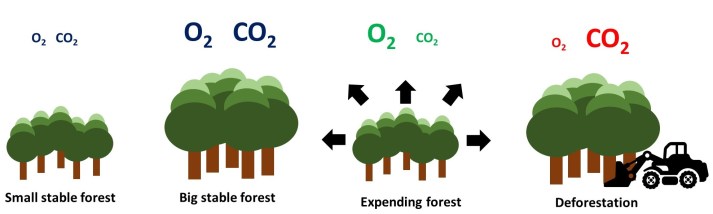
However, to effectively enrich our air with oxygen by a forest, plant organic matter has to be further produced (by plants’ photosynthesis) than degraded (by decomposers). This can be easily summarized as : the forest must be expending ! A forest that remains stable in term of surface (assuming it does not get any more dense) does not produce more O2 than CO2. As a matter of fact, it should rather be seen as a place where carbon is stored, exactly as it is stored in fossil fuels.
In the most optimistic scenario, let’s say the Amazon forest surface is stable. Then, it creates as much O2 as CO2. The ration between O2 production and O2 consumption is balanced. Actually, considering the fauna that breaths in the Amazon forest, it probably consumes slightly more oxygen. And this is in the most optimistic scenario, as we all know that in reality, human deforestation and forest fires are working hard on releasing the stored carbon of the Amazon forest, taking over the role of decomposers …
 Valentin Hammoudi