Whether you work in the health, environment, food, or research sector, the most valuable molecules are proteins. Most proteins we use are extracted from animals, raising availability and ethical concerns. But an alternative exisits: reprogramming cells that are grown in liquid cultures in laboratories so they produce these proteins-of-interest. In a nutshell, these cells are used as biofacturies. Most of the time, we use animal, bacterial or yeast cells for these liquid cultures ; and we call such proteins produced in host cells “recombinant proteins“.
The technology of recombinant proteins has changed our life. The most striking example : insuline! A few decades ago, people suffering from diabetes had to get insuline collected from pigs’ or cows’ pencreas. But nowadays, we produce recombinant insuline in large-scale using bacteria grown in bioreactors. The solutions provied by recombinant proteins produced by cell cultures have nevertheless limitations in terms of quality, cost, and safety.
Plants offer an overlooked alternative. They can produce sophisticated proteins at a lower cost and in large quantities. Plant-based production can be easily scaled up and poses no risk of human pathogens. Many companies have jumped into this opportunity, such as Leaf Expression Systems (UK), Core Biogenesis (France), ORF Genetics (Island), Icon Genetics (Germany) and many more. However, protein production within plants needs optimization, favoring systemic and controllable production throughout the plant.
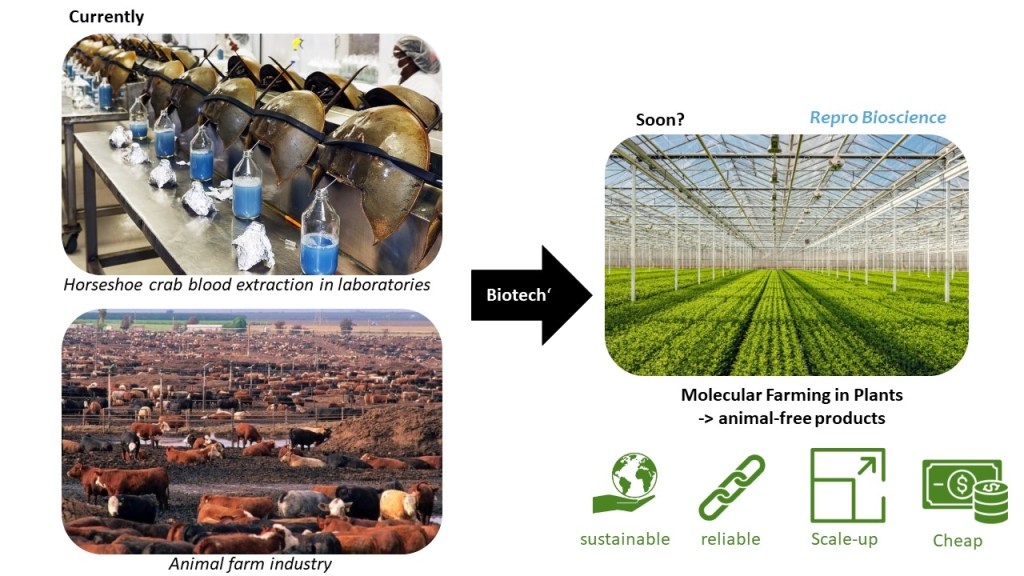
Based on discoveries from my fundamental research project at Freie Universität Berlin, I have created a molecular switch with amazing properties. Thanks to this breakthrough technology based on UV light that we patented, we can accumulate proteins in outstanding amounts across all plant tissues on request, enabling large-scale productions of recombinant proteins in plants. The biotech startup Repro Bioscience has leveraged this innovation for two specific products, both being high-added value molecules with current ethical concerns.
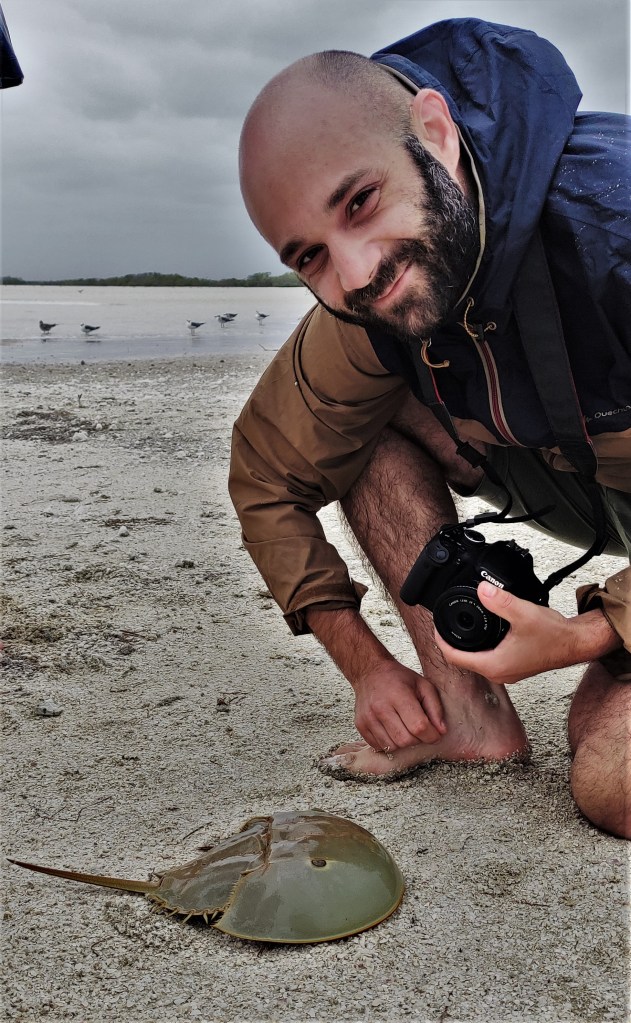
- Proteins for endotoxin tests: Ensuring sterility in substances injected into our bloodstream (for instance vaccines, drugs etc.) is crucial. Current tests rely on blood extracted from intriguing animals that are the most anciant animal species still existing : horseshoe crabs. As we capture them to steal their blood, their population has seriously dropped over the last decades making them at the very best as “vulnerable species”. Because our entire health system relies on their blood and because these animals are progressively disappearing, horseshoe crab blood is currently the 4th most expensive liquid on earth : ~11k€ per liter. Repro Bioscience aims to produce horseshoe crab proteins in plants, eliminating the need for blood extraction and contributing to conservation efforts of this species. A prototype is now ready for tests !
A few numbers for an insight of the market endotoxin tests (from Verified Market Research):
Market size in 2019 : USD 853 million
Forecast of the market size in 2027 : USD 1998 million
CAGR of 12.1% from 2019 to 2027
For more information about the ecological and ethical drama of horseshoe crabs, read this article from National Georgraphic. - Growth factors for Cell Cultured Meat: Cell cultured meat is an ethical alternative to reduce the environmental impact of meat. However, high production costs hinder its market availability, namely because of required growth factors, which represent up to 80% of the production costs of cell cultured meat. Repro Bioscience wants to produce growth factors in plants, reducing production costs and making cell cultured meat more affordable.
A few numbers for an insight of the market of cell cultured meat (from Grand View Research):
Market size in 2022 : USD 246.9 million
Forecast of the market size in 2030 : USD 6.9 billion
CAGR of 51.6% from 2022 to 2030 - This technology is not restricted to these two product, and other possible products include enzymes, cytokinines and antibodies.
In summary, Repro Bioscience leverages the innovative molecular switch technology to enable large-scale production of recombinant proteins in plants. This approach is applied to two specific products: growth factors for cell cultured meat, aiming to make lab-grown meat more affordable and sustainable, and proteins for endotoxin tests, aiming to eliminate the need for extracting blood from horseshoe crabs and preserve their population. Through these applications, Repro Bioscience seeks to advance scientific innovation and contribute to a more sustainable and ethical future.
Want to know more about Repro Bioscience ? Find exta information on this university spin-off startup project in the Pitch Deck.
In a nutshell:

 Valentin Hammoudi