Article written in collaboration with Maxime Blondeau (Cosmorama production), for « Aquagir », and approuved for publication by « syndicat des entreprises du traitement de l’eau Synteau, membre de l’UIE (Union Nationale des Industries et Entreprises de l’Eau)».
Authors: Valentin Hammoudi & Maxime Blondeau
Translation: ChatGPT & Valentin Hammoudi
70% of Earth’s surface is covered by water. However, 97% of this water is salt water, which is not suited for human consumption nor agriculture, leaving only 3% as freshwater. Behind this apparent abundance lies a millennial threat with significant health, political, and technological concerns: the freshwater shortage.
Each individual needs to consume 2 liters per day to maintain a healthy hydration, but freshwater is also essential for many crucial sectors. Agriculture tops the list: nearly 70% of the freshwater used globally is for crop irrigation. This intensive use of water in agriculture exerts additional pressure on already limited resources, especially in arid and semi-arid regions. Agriculture, however, is not the only sector that dependents on this precious resource: chemical, energy, and construction industries also have significant demands. Not to mention the crucial importance of water for public health, as the proper functioning of health services largely depends on reliable access to water. Finally, domestic consumption also plays a role in the use of freshwater.
Toward a Freshwater Shortage?
Population growth, rapid urbanization, climate change, and poor water management are all factors that make access to water increasingly problematic. The figures are alarming: the demand for freshwater has steadily increased since the early 20th century, multiplying nearly sixfold between 1900 and 2000. Even more worring, this increase has accelerated since the 1950s. By 2050, global water demand could surpass available supply in many regions. This catastrophic prospect is already a reality for some areas, and in the near future the lack of freshwater will likely affect regions previously spared by this problem, even in temperate zones like France, where groundwater levels regularly raise concerns.

Global Freshwater Consumption Between 1901 and 2014. Source: Our World in Data
The Technical Miracle of Desalination
In the face of this imminent crisis, a solution has emerged to increase freshwater supply: desalination. This method involves removing salt from seawater to make it fresh, thus transforming an abundant yet otherwise unusable resource into a source of drinking water. Desalination offers the possibility of diversifying freshwater sources, reducing pressure on existing water resources. Another major advantage of desalination is its ability to provide drinking water in regions where freshwater is scarce or contaminated, significantly improving the quality of life for local populations. Additionally, desalination can contribute to food security by allowing the irrigation of agricultural land with desalinated freshwater.
There are no fewer than twenty methods of desalination, including freeze desalination and electrodeionization. However, the two most common and advanced technologies are thermal distillation and reverse osmosis. In a nutshell, thermal distillation involves heating seawater, which then evaporates while the salt remains, allowing the recovery of freshwater from the condensed vapor. Despite its straightforward principle, this technology has been gradually replaced over the last decade by reverse osmosis, which is cheaper and more efficient. Reverse osmosis uses a semi-permeable membrane to separate water from salt and other solutes, producing freshwater in a similar way to a filter or sieve. Nowodays, nearly all new desalination plants in the world are based on reverse osmosis.
A Desalination Boom Since 2000
Over the last 50 years, desalination technologies have seen significant growth. In 2022, there were at least 21,000 desalination plants in over 170 countries, which is twice more than recorded plants in 2012. This exponential growth reflects the increasing enthusiasm for desalination. Many countries are turning to this technology to address the urgent water shortage or as a precaution against this imminent threat. In the Middle East, where population growth and arid conditions make freshwater a precious resource, desalinated water accounts for the majority of consumption in countries like Kuwait (90%), Oman (86%), Saudi Arabia (70%), and to a lesser extent, the United Arab Emirates (42%). Projections suggest that desalination in these countries is far from reaching its peak, as the quantities of desalinated water are expected to double by 2030. It is not surprising that large-scale projects like NEOM, a linear city planned in the middle of the Saudi Arabian desert intended to host over 9 million inhabitants by 2045, rely heavily on desalinated water.
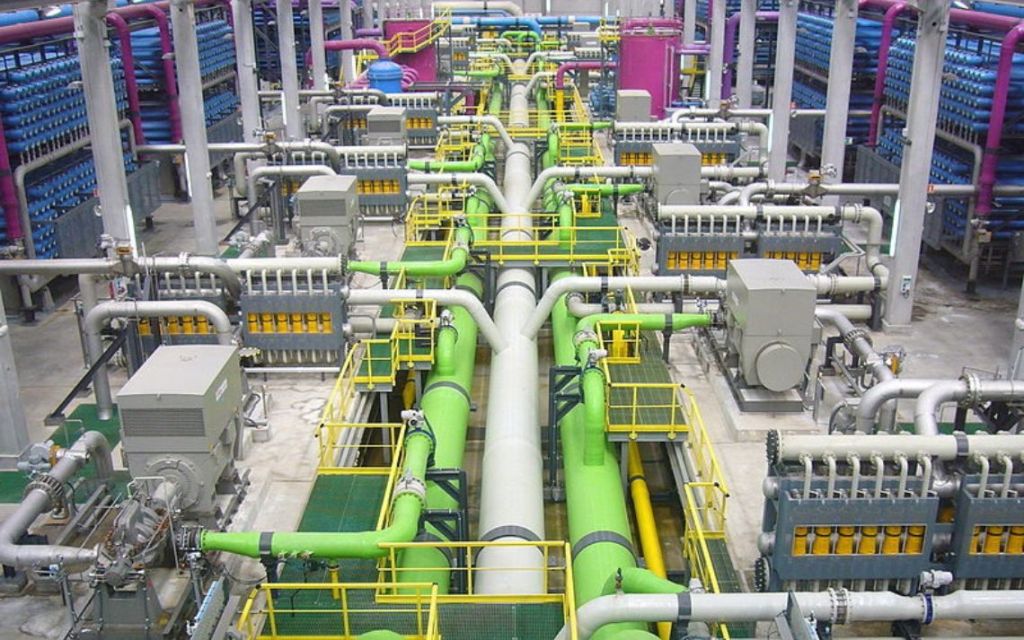
A Reverse Osmosis Desalination Plant on the Outskirts of Barcelona, Catalonia.
Photo Credits: James Grellier (Wikimedia Commons).
A Technology Used Across All Continents
The Middle East is not the only region embrassing desalination as a solution to water scarcity. Currently, this region accounts for only half of the world’s desalination plants. Singapore, for example, has become a global leader in this field, with several operating seawater treatment plants. In Africa, countries like Morocco, Algeria, Tunisia, and Sudan also use desalinated water to supply their populations. Closer to France, Spain faces recurrent summer droughts and has invested in desalination facilities to secure its water supply. This initiative is particularly notable in Barcelona, an important national and European economic center. Even Berlin, located more than 200 kilometers from the coast and with a climate far less hot than the Mediterranean basin, is considering desalination. Because of a lack of drinking water, the German capital is considering the set up of a pipeline to transport water from the Baltic Sea, treated by desalination plants on the coast.
In France, only about twenty desalination plants were recorded in 2022. While the process is not yet widely used, it does not mean it is not receiving significant attention in terms of research and technological development. The public sector plays a major role in the development of desalination technology, but companies are also significantly contributing to it.
A Steep Environmental Cost for Desalination

Floating easily in the Dead Sea due to its high salt concentration (300 g/L). Photo Credits: Toa Heftiba on Unsplash
Desalination of seawater seems at first glance a promising solution to meet the growing needs for freshwater, but it has significant drawbacks. Its high energy cost is often criticized, especially considering that the energy used is often fossil-based. This is certainly one of the limitations of this approach in a context where energy sobriety is crucial to address climate change challenges. Moreover, regardless of the method used, desalination produces highly concentrated saline water discharges, known as brines, which are typically released into the ocean. As the salt concentration increases, the water becomes denser. This is why you floats when bathing in the Dead Sea, known for its high salt concentration (about 300 grams per liter of water, compared to an average of 35 for seas and oceans). When these brines are discharged into the sea, they sink and locally increase the salt concentration of the seabed. Yet, seabed is home to important ecosystems that often harbor significant biodiversity. While marine flora and fauna can tolerate the presence of salt, excessive concentrations caused by brines are toxic to them, endangering marine biodiversity. Additionally, harmful products used to minimize salt deposits in desalination plant equipment also end up in the brines, further degrading the seabed. While brines gradually dilute in open seas, this is not the case for nearly closed bodies of water, where they disperse less easily. This is particularly true in the Arabian-Persian Gulf. The intense desalination industry and the shallow depth of the seabed there exacerbate brine accumulation, intensifying their impact on local marine ecosystems.
A Significant Overall Cost …
Another major drawback: water purified from its salt is not immediately potable. It often requires remineralization, which consits in the reintroduction of minerals that were removed along with the salt (such as magnesium or calcium), adding energy and financial costs, as well as additional technical complications. Finally, the cost of desalination can also be a barrier: it costs about 0.41 euros per cubic meter at the plant outlet for reverse osmosis, and 9 for distillation (although the overall cost of the latter can be reduced through the reuse of steam from combined cycle turbines). Although desalination may seem very attractive on paper, these examples highlight that it is far from being a perfect solution for addressing the freshwater problem on Earth. At least, for now.
… But Promising Scientific Innovations
Recent advances in desalination offer promising prospects for the future. New approaches are being developed to make desalination more efficient, less costly, and above all, less energy-consuming. For example, an invention from MIT (Massachusetts Institute of Technology) in 2023 paves the way for solar-powered desalination, which could be cheaper to produce than tap water. This invention is not the only one; others have also emerged in recent years: microbial desalination, fluorinated nanochannels that prevent salt passage, or Cowa technology that relies on a resin activated by CO2 to absorb salt like a sponge. Another recent development involves the use of desalination waste. Besides salt, seawater contains numerous minerals and metals used in industry, such as molybdenum, boron, or lithium. Their concentration in seawater is very low, so they are currently sourced from land mining. However, like salt, their concentration increases drastically in brines. The idea is to incorporate desalination into a circular economy perspective by using its waste as a source of minerals and metals. This is notably being developed by the European project Sea4Value.
All these technologies suggest a medium-term vision of efficient, economical, and more environmentally friendly desalination. However, since the freshwater crisis is a global problem akin to climate change, it is essential that technological advancements in desalination benefit everyone, not just a limited number of countries or companies.
In conclusion, desalination represents a promising solution to the global freshwater crisis. By converting seawater into freshwater, desalination can provide a reliable and sustainable source of drinking water for communities worldwide. However, for desalination to be truly effective and sustainable, it is necessary to address the technical, economic, and environmental challenges associated with this approach. It is also crucial to adopt a balanced and inclusive approach in the development of desalination, considering the needs and perspectives of all stakeholders. Ultimately, desalination has the potential to transform how we manage and use water, but this will require collective commitment and long-term vision to overcome obstacles and fully realize its potential.
Featured Photo credits: Toa Heftiba sur Unsplash
 Valentin Hammoudi